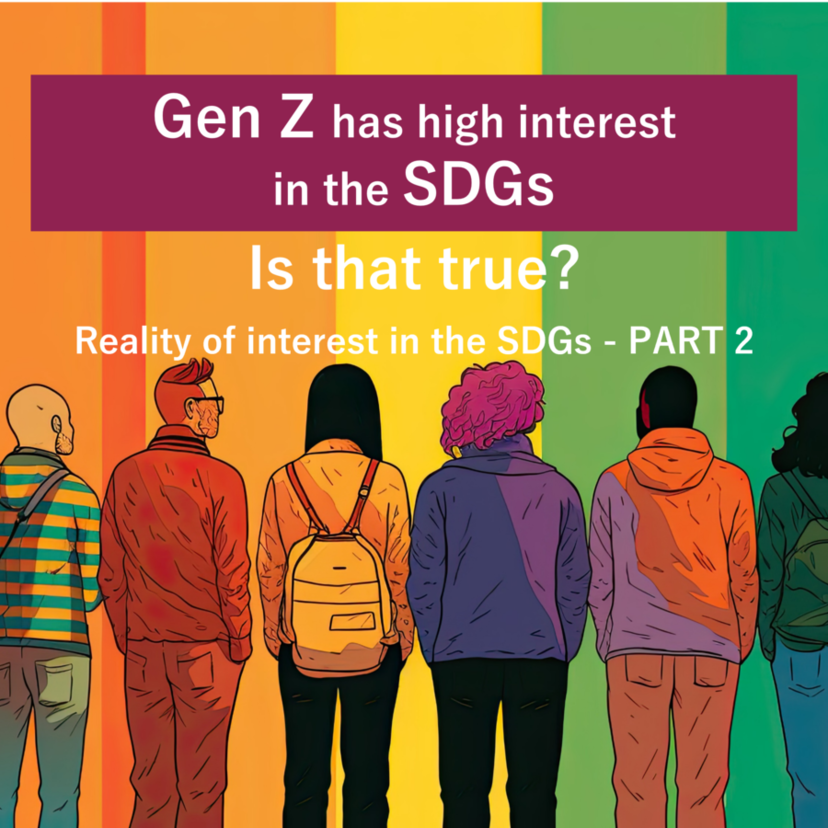

This is part 2 of 3 of this article.

Gen Z has high interest in the SDGs, is that true? Reality of interest in the SDGs - PART 1
https://manamina.valuesccg.com/articles/2946How should companies address their SDGs initiatives for a positive response and effectiveness and create SDGs products that lead to business opportunities? Based on VALUES’ survey and online behavioral data, we researched “action / interest / non-interest" consumers to understand how to approach action/interest groups.
Gen Z has high interest in the SDGs, is that true? Reality of interest in the SDGs - PART 3
https://manamina.valuesccg.com/articles/2968How should companies address their SDGs initiatives for a positive response and effectiveness and create SDGs products that lead to business opportunities? Based on VALUES’ survey and online behavioral data, we researched “action / interest / non-interest" consumers to understand how to approach action/interest groups.
■Comparing of personas for active, interested, and indifferent groups
So, how can consumers take action towards the SDGs?
In this research, we categorized the SDGs into three groups: the "action group" who are taking SDGs-related action, the "interest group" who know about the SDGs but have not put them into practice, and the "indifferent group" who are not familiar with the SDGs or have never heard of them. We conducted an analysis to clarify why the “action group" is more proactive and why the "interest group" does not take action.
“Action group,” “interest group,” and “indifferent group” categorized based on their attitude toward the SDGs
First, let me introduce the personas across each group.
First is the SDGs action group. About 10% of respondents had a relatively high annual household income of approximately 5.8 million yen. When we mapped their interests based on a survey, hobbies such as listening to music, cooking, and gardening stood out, indicating that they lead a sensible and mindful lifestyle. Another characteristic of this group is that they have a strong interest in political economy, and it can be said that there are many socially conscious people in this group.
Persona of the SDGs action group
Certain characteristics can also be observed in the websites they visit. Compared to the overall rankings, major news media such as NHK, Yahoo! News, and Asahi Shimbun ranked high. This suggests that many people regularly read the newspaper and watch the news.
Next is the SDGs interest group. A significant number of people fell into this group, accounting for more than half of the respondents.
Persona of the SDGs interest group
Regarding interests, hobbies such as movies/TV, domestic travel, and money/investment stand out. Compared to the action group, it may be said that people in this segment enjoy hobbies that can be enjoyed alone and actions that bring some sort of benefit. In addition, regarding the website visited, it seems that the use of e-commerce is a unique feature, although it is not obvious due to the large number of people in this group.
Last is the SDGs indifferent group. There are slightly more women in this segment, and among the three segments, the annual household income is lower.
Persona of the SDGs indifferent group
In addition, in terms of interests, many liked entertainment-related activities such as games, anime, and pachinko (Japanese gambling pinball machine), and the websites they visited were review services related to games and demos/trials.
■In fact, the interest group is also taking SDGs-related actions
Next, let's focus on the action and interest groups where companies can expect their SDGs initiatives to be effective. We would like to introduce the results of a survey on the themes of interest in the SDGs for these two groups.
SDGs interest themes (by action group and interest group)
Overall, the action group has a higher interest, but themes that exhibited a difference of 10% or more include "Life on land," "Partnership for the goals," "Responsible production," and "Reduced inequalities," exhibiting strong interest in social themes. This seems to be a characteristic unique to the socially conscious segment.
Next, we will introduce research on purchasing trends. We analyzed whether people were taking actions that would lead to achieving the SDGs, such as using their own reusable shopping bags, recycling, and saving electricity.
Purchasing behavior to achieve the SDGs (by action group and interest group)
On the other hand, even those who were interested were practicing “bringing their own shopping bag,” “saving electricity,” and “acting with energy conservation in mind.” Although the main purpose may be to save money, as a result, they are practicing behaviors that lead to achieving the SDGs.
From these results, it can be said that it is possible to resonate not only with the action group but also with the interest group.
※日本語での記事はこちらをご確認ください
「Z世代=SDGs高関心」は本当か?アンケートとWeb行動ログから見えるSDGs関心層の実態
https://manamina.valuesccg.com/articles/2877企業がSDGsの開発目標に取り組む際、どんな点に留意すれば反応や効果が得られるのでしょうか。またSDGs関連商品を開発する際には、どんな切り口から商品化すればビジネスチャンスにつながるのでしょうか。 今回、ヴァリューズが行った約15,000人規模のアンケート調査とWeb行動ログ分析から、「SDGs行動層/関心層/非関心層」それぞれの生活者の実態を明らかにしました。結果から見える行動層/関心層へのアプローチ方法をご紹介します。 ※詳細なセミナー資料は記事末尾のフォームから無料でダウンロードできます。


















Born and raised in the Bay Area, U.S.A, I was fascinated by the different social and purchasing behaviors between Japanese and American consumers. I studied communication for undergrad and international marketing for my graduate studies. My professional background is in bilingual recruitment and Japanese-English translation.