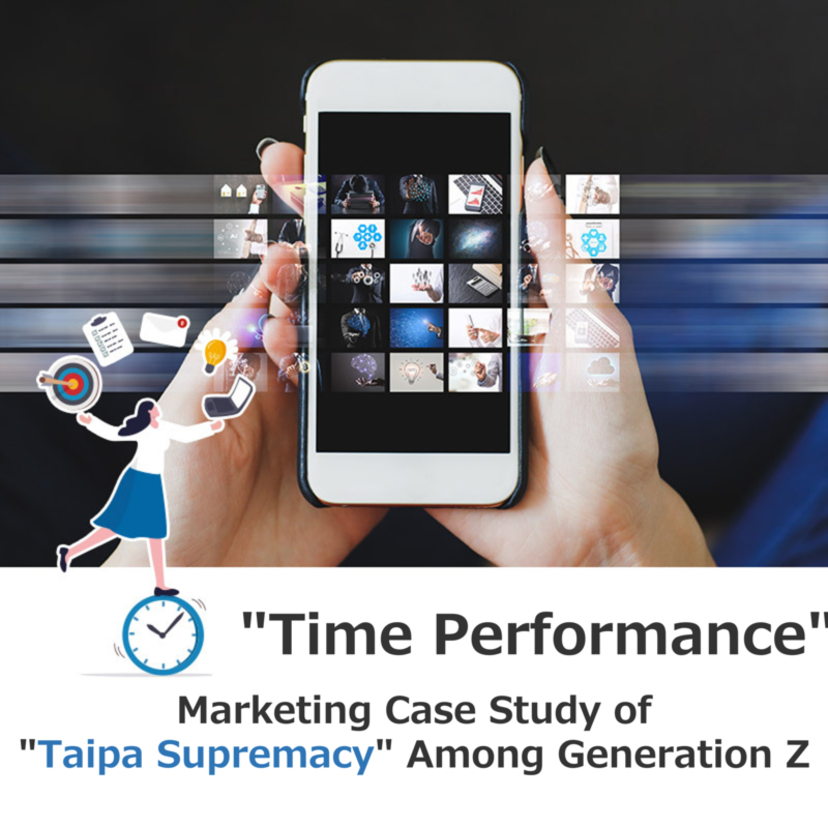

What is a "taipa"?
"Taipa" is an abbreviation for "time performance" (time vs. effectiveness). It expresses the degree of effectiveness for the time spent and the degree of satisfaction for the time spent.
In contrast to "cospa (an abbreviation for 'cost performance')," which is used to describe the effective use of money, "taipa" values the effective use of time.
For instance, the following are some examples of "taipa" behaviors:
・Not participating in useless drinking events that they don't feel are "taipa," worth their time.
・Organizing questions in advance in order to increase "taipa," or efficiency.
・Enhancing “taipa” for hobbies, like watching movies in 2x speed to finish a movie in an hour.
In such ways, younger people are exhibiting more and more "taipa" behaviors in various parts of their life, from their private lives to professional settings.
■Background of the "taipa" trend
"Taipa" became a trending word with the publication of "People Who Watch Movies on Fast Forward" (Toyofumi Inada / Kobunsha Shinsho) in April 2022. In "People Who Watch Movies on Fast Forward," it suggested that Generation Z values "taipa" in all situations.
The following are some of the several ways they watch movies:
・"While" watching (multitasking): Watching a video while doing something else
・Speed watching: Watching a video at an accelerated speed
・Skipping: Skipping over content that does not interest you
・Spoilers: Finding out more about what to expect in advance
A survey by SHIBUYA109 lab. also found that about half of Generation Z views content at faster speeds, and more than 80% multitask while watching.
According to research by SHIBUYA109 lab.
Translated by VALUES, inc.
■Factors that led to high levels of consciousness for "taipa”
There are two factors behind the high level of consciousness among Generation Z.
They are in an environment they are overwhelmed with videos that they want to watch or need to watch. In addition, with the proliferation of social media, they need to watch content efficiently in order to keep up with the conversations they are having with their friends.
The widespread popularization of video-related subscription services
First is the proliferation of video streaming services such as Netflix and Amazon Prime. The ability to watch large numbers of films and dramas at low prices has led to an explosive increase of highly-popular content among Generation Z.
It is believed that they are highly conscious of "taipa" due to the need to view a large amount of content in a limited amount of time.
Fast-changing social media trends
A survey by SHIBUYA109 lab. revealed that more than 80% of Generation Z use social media on a daily basis.
Trends change on social media on a daily and hourly basis. In order to keep up with friends, they need to follow the trends and experience the content as quickly as possible.
With limited free time, they need to digest content in a "taipa," or timely, manner.
According to research by SHIBUYA109 lab.
Translated by VALUES, inc.
Examples of "taipa" video content
"Taipa," which emphasizes time efficiency, is increasing in importance among younger generations including Generation Z. Here are some specific examples of the kind of video content preferred by Generation Z.
■Fast movies
A "fast movie' is a video with subtitles and narration that reveals the story of a film in 10 minutes.
These videos, which briefly introduce a movie from its synopsis to its ending, were posted on video-sharing websites. This kind of content became popular in the spring of 2020 and increased in the number of uploads on YouTube in response to the growing demand during the COVID-19 lockdown and "stay-at-home" orders.
There was an increase in the number of viewers that possess the psychology that "it is more beneficial to watch a lot of free 'fast movies' than to watch the actual movies" to enjoy them with a "taipa" manner.
However, “fast movies” may violate copyright laws. In 2021, three contributors of "fast movies" were arrested and prosecuted. As of 2022, most fast films have been removed from YouTube.
■Short-form videos
Short-form videos are short, vertical videos that can be viewed on smartphones. Major short-form videos are posted on TikTok, YouTube Shorts, Instagram Reels, and LINEVOOM.
The length of the video is often set at around 60 seconds.
Short-form videos have become a popular service for Generation Z because they can be easily viewed during their spare time.
A survey of short-form video usage conducted by SOMEWRITE found that approximately 70% of Generation Z have watched short-form videos.
According to research by SOMEWRITE
Translated by VALUES, inc.
Examples of marketing inspired by "taipa"
The value of "taipa," which is strongly asserted among Generation Z, can be utilized in marketing.
Below are several examples of successful marketing efforts utilizing video content. It can be applied to both individual and corporate marketing.
■"Zanzo ni Kuchibeni wo": 1995 novel is urgently reprinted
In 2021, 35,000 copies of the novel "Zanzo ni Kuchibeni wo" (Yasutaka Tsutsui / 1995 / Chuokoron Shinsha) was urgently reprinted. It was sparked by a TikTok post by "Kengo (@kengo_book)" that introduced the novel. The video was viewed 9.6 million times on TikTok and caused a sharp increase in sales after 30 years since it was first published.
Link to video
If the letter “A” disappeared from our world, what do you think would happen?
This book starts with a shocking statement. In this novel, the words slowly disappear.
If I were to explain this in detail, if the letter “A” were to disappear, people would no longer be able to use the words “Ai” (meaning “love” in Japanese), and “Anata” (a respectful way of saying “you” in Japanese).
If we are unable to use the word “Anata,” we would only be able to use “Kimi” (a condescending way of saying “you”) and “Omae” (a rude way of saying “you”) instead.
As the chapters progress, the words that can be used become more and more limited, so the language gradually becomes rough, harsh, and rude. This novel has another terrifyingly painful situation. That situation is…Please read the novel and find out!!
In response to the popularity brought by TikTok, original point-of-purchase ads of the book were displayed in bookstores and were often seen used for book reports among elementary school students.
■Kimchi no Ie Sado Island (Kimchi House, Sado Island): Kimchi sales increase 40-fold!
Kimchi House (@kimuti.house.jp.ne.co), which produces kimchi on Sado Island in Niigata Prefecture, is a great example of how sales have taken off.
A video exhibiting dynamic knife work cutting napa cabbage when making their kimchi has received over 3.1 million views. Orders flooded in from all over Japan for mail order, and sales increased more than 40-fold in the first two months after joining and posting on TikTok.
TikTok's live streaming function "TikTok LIVE" was also used, and the napa cabbage kimchi, which announced sales of a limited quantity of 200 (worth about 300,000 yen), were sold out in just 3 minutes.
Link to video
@kimuti.house.jp.ne.co 1996年創業。まだ佐渡島にキムチがなかった頃に自分で食べたくて作りました。
♬ オリジナル楽曲 - キムチの家 - キムチの家@佐渡ヶ島
■Toba View Hotel Hanashinju: An increase in job applications
Toba View Hotel Hanashinju (@tobaview), a hotel in Mie Prefecture, was ranked No. 1 in the region by the travel booking site Jalan through the use of TikTok.
A video of three hotel staff in suits dancing to a popular dance tune has trended with over 2.2 million views. The big gap between the how serious and diligently the staff work and how they dance was a big hit among users.
Link to video
It also had an impact on employee recruitment. The TikTok video triggered an increase in job applications from high school students who sensed the open work culture and atmosphere and felt that they "want to work at a ryokan (traditional Japanese hotel) like this." Despite the difficulties in recruiting in previous years, the recruitment process went smoothly in 2021.
This is a good example of not only marketing a product or service, but also improving the brand image.
Values among those highly conscious of "taipa"
What are the values and consumption behaviors of the "taipa"-conscious Generation Z? Here are some values and consumption behaviors unique to Generation Z that are not common among other generations.
■Quickly look up on social media
With the Internet making it easier to access information, there is a tendency for people to immediately look things up on social media instead of visiting the website to confirm or research when they are not sure or do not know something.
For example, the following are some ways they use social media to find information:
・Look up reviews on Instagram to find a restaurant nearby
・Watch YouTube videos to learn something new
・Use PowerPoint-style Instagram posts with multiple images to review what they’ve learned
In corporate marketing, a strategy would be to open an official social media account or otherwise enhance content related to the product or service.
■Prefer spoiler consumption
Spoiler consumption refers to the use of products and services after having studied their content in advance. Generation Z tends to prefer spoiler consumption due to their ""taipa" behavior of "not wanting to waste time" and "wanting to get maximum results with minimal effort."
Some examples include the following:
・Checking the ending of a movie on a review website before watching the movie
・Reading a summary online before reading the book
・Asking the person what he/she wants for his/her birthday before buying a gift
Some may ask, "Is it still enjoyable after watching spoilers?" but they recognize the following positive aspects:
・It is more enjoyable if knowing the content of the movie in advance
・The book can be purchased with no regrets after being satisfied with what to expect
・Ensures that the birthday gift will be highly satisfactory for the person
It can also be said that by spoiling the details in advance, it also covers the "cospa," or cost-effective, aspect as it helps avoid wasting money.
■"Tagging" and "tabbing"
"Tagging" refers to searching using hashtags on social media. While searching on Google is called "Googling," searching with hashtags (#) on social media is called "taguru," or "tagging."
It is possible to search for desired information from photos using keywords that express emotion and feelings, such as "cute" and "stylish."
On the other hand, "tabbing" is the process of finding information that users like on Instagram's Explore tab. The Explore tab is the screen that appears when you tap the magnifying glass symbol on Instagram's home screen. It displays recommendations of posts that users like based on views, comments, and time spent.
Because users' favorite information is immediately displayed, Generation Z is "tagging" and "tabbing" information to find it.
It is a good idea to set up social media hashtags and exploring the Explore tabs based on this type of search behavior as well.
Summary
"Taipa" (time performance) is about time efficiency. More and more of Generation Z are "watching while multitasking" or “speed watching.” More and more businesses are using TikTok and other video content as successful marketing strategies, and marketing activities inspired by "taipa" will become more important in the future.
When creating video content, it is important to plan based on keywords that users are interested in and behavioral data. Dockpit investigates markets and consumers based on online activity data of approximately 2.5 million people. By referring to "which keywords Generation Z is searching for" and "what kind of web content they are viewing," you can plan appropriate and effective content.
Why not make effective use of marketing data analysis to address the "taipa" supremacy among Generation Z?
About Dockpit
▼Dockpit is an online behavior analytics tool provided by VALUES, Inc., and it allows you to access online behavioral data (updated monthly) via your browser so you can research competitor websites and investigate trends. There is a FREE version of Dockpit, so if you are interested in using it, please register below.

※日本語での記事はこちらをご確認ください

タイパとは?Z世代が重視する「タイパ至上主義」の背景とマーケティング事例
https://manamina.valuesccg.com/articles/2112Z世代の多くは、生活のさまざまな場面でタイパ(タイムパフォーマンス)を意識しています。「タイパ至上主義」という言葉が登場するほど、Z世代は時間効率を重視しているのです。この記事では、Z世代の購買心理・最新のトレンドを知るために、タイパの概要や価値観、マーケティング事例を解説します。
















Born and raised in the Bay Area, U.S.A, I was fascinated by the different social and purchasing behaviors between Japanese and American consumers. I studied communication for undergrad and international marketing for my graduate studies. My professional background is in bilingual recruitment and Japanese-English translation.